

Let's talk about dust
Twelve thousand UK workers die annually from lung disease. It is time to face the microscopic truth.
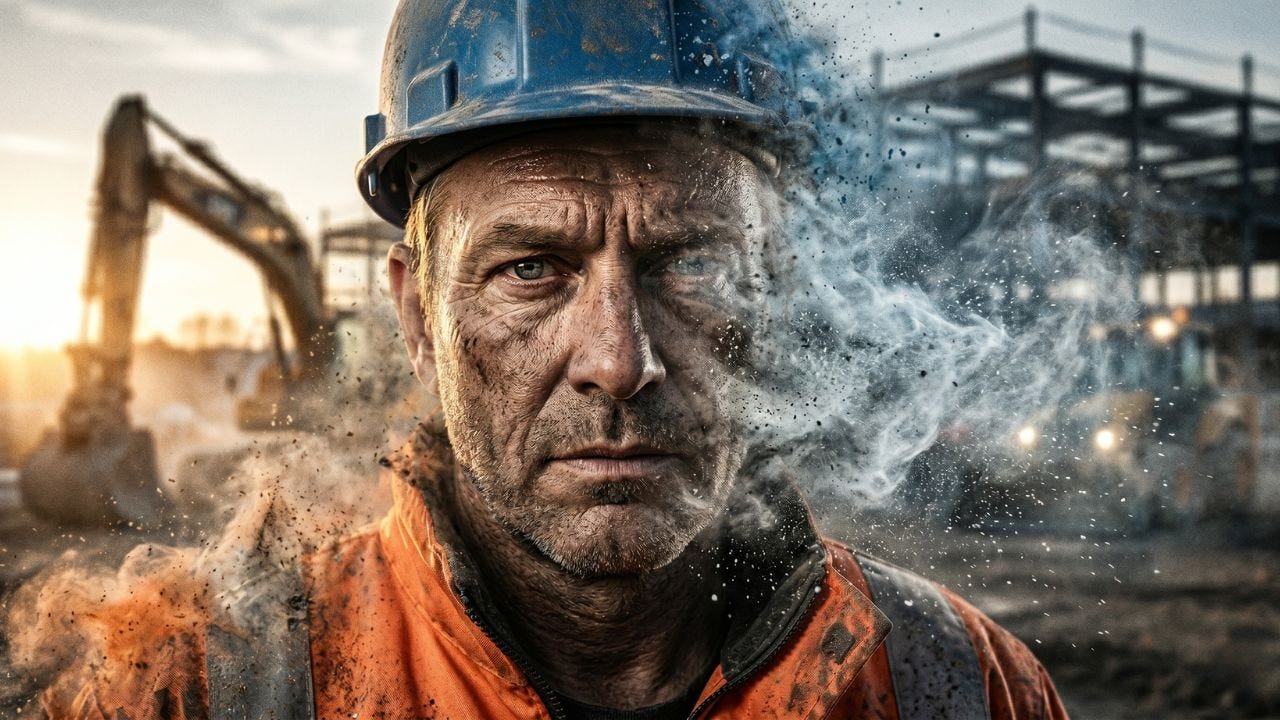
Let’s talk about dust. More specifically, let’s examine the microscopic, invisible assassins hiding in our concrete, brick, engineered stone, and mortar: respirable crystalline silica.
It is incredibly easy to brush off the abstract threat of a lung condition when the danger is not swinging at your head like an uncontrolled crane payload. However, the statistics surrounding occupational lung disease are terrifying. Every single year in the United Kingdom, approximately twelve thousand people die from lung diseases definitively linked to past exposures at work. Compare that staggering number to the one hundred and eleven fatal workplace accidents reported in a recent year, and a startling reality emerges.
An astonishing ninety-nine percent of deaths caused by work can be attributed to long-term ill health; only one percent are due to poor safety. For those of us working in the construction and demolition sectors, the picture is even more alarming. A construction worker in the UK is one hundred times more likely to die from an occupational disease than from a sudden workplace accident.
Silica dust is a leading contributor to this grim statistic. Because the dust particles generated by cutting, grinding, and crushing are so incredibly fine, they easily bypass the body’s natural respiratory defences and embed themselves deep within the lung tissue. Over the course of a career, or sometimes even just a few short months of very heavy exposure, this invisible hazard silently destroys the respiratory system.
Silicosis is the world’s oldest known occupational disease, yet it remains one of the most persistent and devastating conditions in the modern trades. As the crystalline silica particles settle deep into the lungs, they cause severe inflammation. This gradually leads to areas of hardened and permanently scarred lung tissue known as fibrosis. Because scarred lung tissue cannot function or expand properly, victims are left with a persistent cough, severe shortness of breath, and chronic, debilitating fatigue. In advanced stages, sufferers eventually find simple, everyday activities like walking across the room or climbing the stairs completely exhausting. They may become largely confined to their beds as respiratory failure sets in.
Beyond silicosis, inhaling this fine dust is definitively linked to lung cancer and chronic obstructive pulmonary disease. The damage does not stop at the lungs, either. Extensive studies and epidemiological evidence have shown that heavy silica exposure significantly increases the risk of other life-threatening conditions, including heart failure, tuberculosis, arthritis, and even kidney disease.
The current HSE crackdown and heightened enforcement were heavily prompted by the recent, tragic deaths of two young workers from silicosis. This spurred the authorities into immediate and aggressive action. The primary target of the regulator’s current outrage is the dry cutting of engineered stone. Engineered stone, which is incredibly popular for kitchen and bathroom worktops, can contain up to ninety-five percent crystalline silica.
The HSE has declared the dry cutting of this material completely unacceptable and illegal. If you think the regulatory bodies are just issuing strongly worded memos and hoping for voluntary compliance, think again. The planned one thousand plus inspections are already well underway. They are heavily targeting fabricator sites, quarries, and construction zones to actively penalise non-compliance. Inspectors are deliberately hunting for businesses that cut corners.
Under the Control of Substances Hazardous to Health Regulations, employers have a strict, non-negotiable legal duty to assess risks and prevent or adequately control exposure to this deadly dust. In Great Britain, the Workplace Exposure Limit for respirable crystalline silica is currently set at zero point one milligrams per cubic metre, calculated as an eight-hour time-weighted average. It is absolutely crucial to remember that this numerical limit is an absolute legal maximum, rather than a target to aim for. The overarching goal mandated by law must always be to reduce exposure to a level as low as reasonably practicable.
In fact, many health and safety advocates, including the Unite union, argue forcefully that the current British limit is still dangerously high. They regularly point out that in the United States, the established safety standard is exactly half of ours, at zero point zero five milligrams per cubic metre. Unite has strongly opposed the current UK standard. They highlight estimates that exposure precisely at the legal limit over fifteen years still represents a 2.5 percent risk of developing silicosis. Consequently, relying purely on hitting the legal benchmark is a highly risky game, and true professionals must strive to engineer out the hazard completely.
As if the direct threat to the worker was not enough to force a change in habits, there is a secondary danger that rarely gets the attention it deserves on the job site. Secondary silica exposure occurs when workers unknowingly carry hazardous dust home to their families. Silica particles are so incredibly fine that they easily cling to heavy work clothes, embed into skin and hair, and settle deeply into the fabric seats of a work van. When a demolition professional returns home without showering or immediately changing out of their contaminated gear, the invisible dust is released directly into the household environment.
Over time, spouses, children, and elderly relatives breathing the air in their own living rooms can develop the exact same progressive, fatal lung diseases as the workers themselves. The home offers no respiratory protective equipment and no heavy-duty extraction systems. This makes vulnerable family members sitting ducks for a hazard they never signed up for.
Personal injury and wrongful death lawsuits are already emerging rapidly in this space. Legal teams are targeting employers who fail to provide proper decontamination areas, locker rooms, or laundering services. The liability of failing to properly control dust now extends far beyond the perimeter fencing of the construction site.
The sheer volume of dust generated on our sites makes it dangerously easy to become completely desensitised to it. We see it every single day, coating our boots, our tools, and our heavy machinery. But the current regulatory climate has shifted rapidly and permanently. With inspectors openly declaring war on poor dust control and actively deploying to enforce the law, the financial, reputational, and legal risks of ignoring silica are mounting steeply.
More importantly, the devastating human cost of this entirely preventable disease is simply too high to accept. No one enters the demolition or construction trades expecting an easy ride. It is physically demanding, difficult work that requires serious grit and technical expertise. However, demonstrating that professional toughness should not require sacrificing our lungs or inadvertently poisoning our families at the end of a shift.
Very good post Mark. I agree about the EH40 exposure limits and in that connection make one comment, one of the biggest H&S mistakes I see on site is working to the EH40 exposure limits - and in one sense it's understandable as it's an HSE publication, but companies should be setting their own benchmark limits relative to EH40 - the standard benchmark is 10% of the WEL - that's what should be aimed for. The EH40 limits are a declaration of the levels of exposure that have not been known to cause health issues. It is not a declaration of a safe level so it's not there to hide behind. As time goes on and more information is fed back from the medical world, these limits will only reduce. Companies should establish their own benchmarks and in the case of RCS, this will be 0.01 mg/m³. What do you think?