

Mind the Gaps
While marketing teams promise total fleet solutions, major machinery brands deliberately ignore massive market sectors. Is this a strategic focus or a refusal to join the race to the bottom?
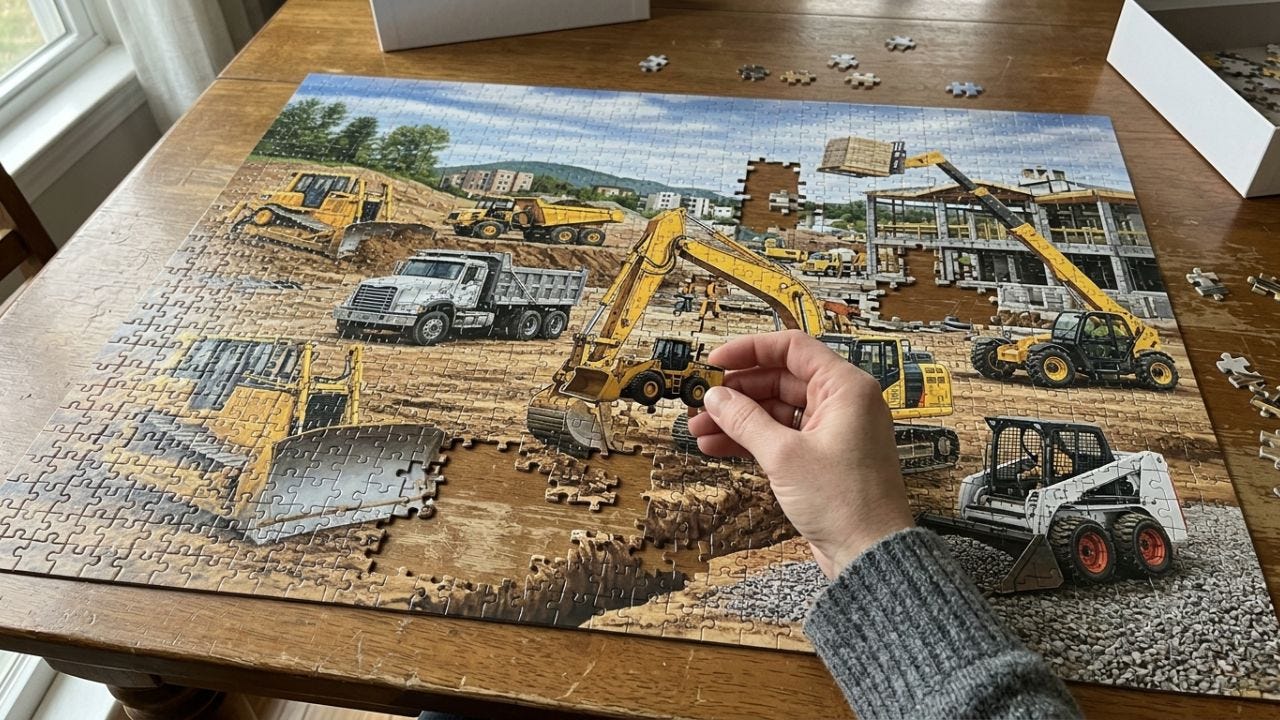
Walk into any major international construction equipment exhibition and you are instantly greeted by a sprawling sea of yellow, orange, red, and blue iron. The message from the marketing departments is clear, uniform, and loud: “We are your total solution provider. One stop, one manufacturer, every job and every application covered.”
Yet, if you step away from the glossy brochures and take a cold, analytical look at the actual product lines, a very different picture emerges. There are glaring, and presumably deliberate, gaps in the product ranges of some of the world’s most respected machinery manufacturers.
Why do these empty spaces exist? Are they strategic blind spots, or are they the result of a calculated, disciplined refusal to join every single race?
Consider Kobelco. The Japanese powerhouse has built a formidable reputation on the back of its hydraulic excavators and crawler cranes. Operators rave about their speed, efficiency, and refined hydraulics. Yet, if a loyal Kobelco fleet owner requires a wheel loader to feed a crushing plant or clear a job site, they have to look elsewhere. Kobelco has chosen to stand entirely clear of the wheel loader market. Is this a case of a manufacturer knowing its exact engineering strengths and refusing to dilute them, or is it a missed revenue stream in a major global sector?
Then we have Liebherr. The family-owned technology group is synonymous with high-quality, high-capacity earthmoving and mining kit. However, if you require a mini excavator for a confined urban site or utility work, Liebherr can’t help you. The smallest tracked model in their line-up is the 14-tonne class R 914 Compact. Liebherr has completely swerved the high-volume tracked mini excavator sector. What drives a manufacturer to ignore the massive volume of the sub-10-tonne market? Is the fiercely contested mini-digger market simply seen as an unprofitable race to the bottom for such a premium brand?
Perhaps the most historical anomaly lies closer to home. Across its celebrated 80-year history, JCB has conquered everything from the backhoe loader and telescopic handler to tracked excavators and wheel loaders. Most recently, the company re-entered the compact ADT market too. They have engineered machines for almost every niche of construction work, but they have never built a dozer. Why has this sector been completely ignored by the Staffordshire giant? Does the dozer market lack the necessary global volume to justify the immense cost of ground-up engineering, or did JCB simply calculate that competing directly with established track-type tractor brands was a war not worth fighting?
You see the same selective philosophy working in reverse when you examine the leading compact machinery specialists. For decades, brands like Takeuchi and Kubota have dominated the global mini excavator market, building fierce brand loyalty among plant hire firms and groundworks contractors. For a long time, these brands drew a firm line at the 8-tonne mark.
Lately, we have seen some tentative steps across that boundary. Takeuchi now offers the 15-tonne TB2150, expanding into the midi and large excavator market. Kubota has taken a different route to fill its own gaps. Through a strategic OEM badging agreement with Liebherr, Kubota now offers 9-tonne and 11-tonne wheeled excavator models powered by their own engines.
But these moves only highlight the deeper question. Why did it take so long? Why do these compact specialists still stop well short of the heavy crawler excavator market? Is there a cultural barrier within these companies that prevents them from transitioning from compact specialists to full-line heavy equipment players?
To understand the strangeness of these missing links, you only have to look at the market leaders. Caterpillar and Komatsu, the two undisputed heavyweights of the global construction equipment sector, have long operated on a philosophy of total market saturation. They offer a full line-up. From a 1-tonne micro digger to an 800-tonne mining shovel, along with the loaders, dozers, scrapers, and graders to match. They believe that a global dealer network is most effective when it can satisfy every single requirement of a multi-national contractor.
Furthermore, the new breed of ambitious Chinese manufacturers, such as Sany, XCMG, and Zoomlion, are rapidly adopting this exact full-line blueprint. They are entering every conceivable equipment sector simultaneously, backing their play with massive manufacturing capacity and competitive pricing.
Against this backdrop of aggressive expansion, the restraint shown by Kobelco, Liebherr, and JCB is striking. It leads us to a fundamental question regarding corporate philosophy in the modern era: Is the full-line strategy actually a relic of the past?
When you look deeply into these product gaps, several distinct theories emerge to explain why a multi-billion-pound manufacturer would leave a glaring hole in its line-up, starting with the compelling argument for pure engineering focus. Is it truly better to be a master of one specific craft rather than a jack of all trades? Kobelco’s total devotion to the excavator allows them to pour their research and development budget into hydraulic efficiency and structural durability, rather than dividing their engineering talent across heavy axles, transmissions, and complex loader geometry.
Beyond engineering focus, you also have to question how these missing products align with a manufacturer’s broader global strategy. Demand for specific machinery classes varies wildly across regional lines. Wheeled excavators, for instance, are highly popular in urban Europe but remain a niche product in North America, while tracked mini excavators sell by the tens of thousands in the UK and France but find a very different market dynamic in developing economies raised on backhoe loaders. If a manufacturer’s primary dealer network and core profitability are rooted in regions where a certain product class is unpopular, it makes little sense to waste capital to build it.
Finally, there is the undeniable element of market saturation and the myth of volume. A widespread perception exists within the industry that certain sectors are already so oversaturated that entering them is financial suicide. The dozer market is tightly defended by long-established players with massive brand loyalty, and the compact excavator sector is crowded with dozens of brands slashing margins to win fleet deals. A specialist manufacturer must naturally ask why they should spend hundreds of millions developing a competitive machine, only to enter an overcrowded room and fight over crumbs.
Ultimately, these missing links may not be failures of ambition at all. They may well be the ultimate expression of corporate discipline.
By deliberately leaving these gaps unfilled, these manufacturers are making a quiet but profound statement: We do not need to be everything to everyone to win.
But as the market consolidates and the full-line Chinese giants continue to gain ground, you have to wonder how long this discipline can last. Will the specialists be forced to eventually plug the holes in their ranges via badging agreements and joint ventures, or will the missing links remain a permanent testament to the power of saying “no”?
