

On the Make
From staged car crashes to tactical laundry, we’re living in a world where ouch is immediately followed by a legal consultation; where we’ve traded community for compensation.
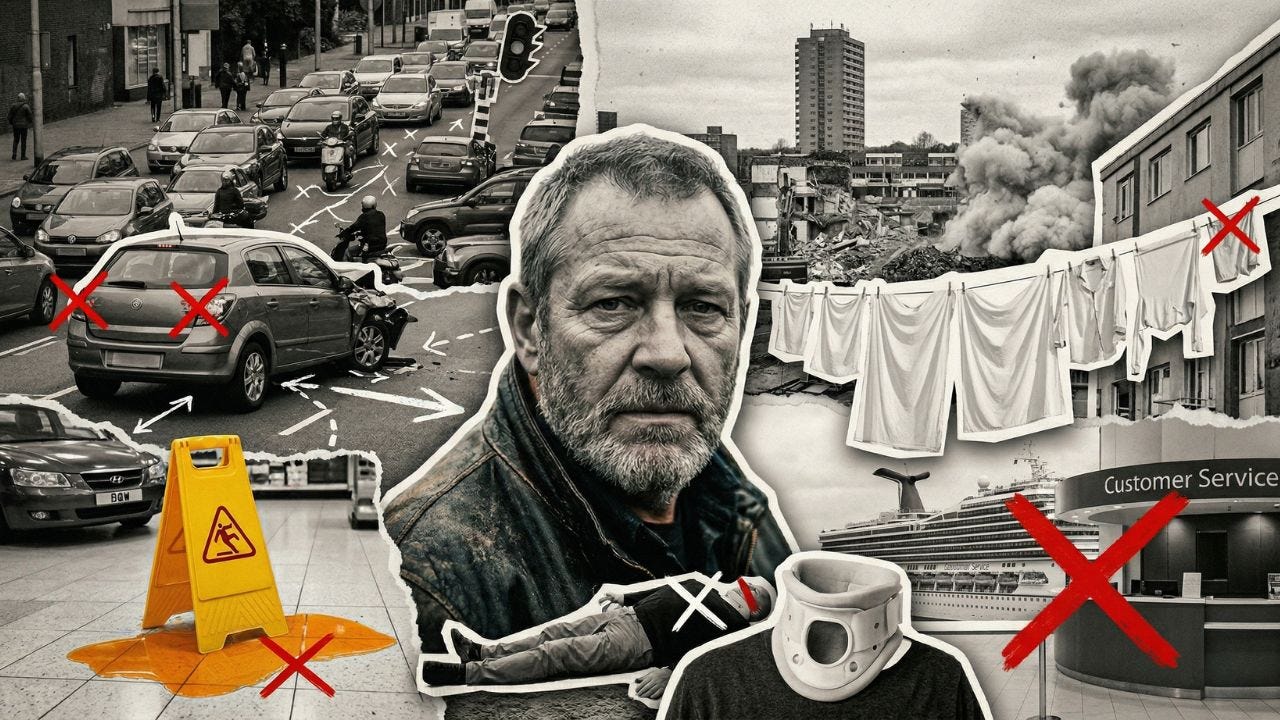
We are living in a world where – seemingly - everyone is on the make.
We have moved from a society of “Ouch, that hurt” to “Ouch, where is my solicitor?” My own travels through this comedy of errors we call modern life is peppered with examples of everyday people on the grift.
Take, for instance, a trip to the local supermarket many years ago. I was with my eldest son, who was about five at the time; an age where gravity is less a law of physics and more of a personal challenge. We came across a puddle of orange juice. Now, in a sane world, a supermarket worker sees a spill and fetches a mop. In our world, they fetch a yellow plastic A-frame sign and leave the juice there, presumably waiting for it to catch out an unsuspecting shopper.
I told my boy to stay clear. Naturally, he did the opposite. He ran, he slipped, he went down like a sack of spuds, and he started wailing. Before I could even reach him, two women descended upon him. Now, you might expect a bit of maternal comfort or perhaps a “There, there, young man.” Not a bit of it. They looked at a crying five-year-old and their first instinct - their very first thought - was: “You should sue the supermarket!”
Think about the sheer, hollowed-out cynicism of that. A child is bleeding or bruised, and instead of a hug, they offer a litigation strategy. It is as if the milk of human kindness has turned sour.
Then we have the “Crash for Cash” brigade. I was driving near home, minding my own business, when the driver of the car in front decided to play a game of “Brake-Light Roulette.” The lights turned green, they edged forward, and then slammed on the brakes for no discernible reason. CRUNCH. I was doing all of three miles per hour. I have had more violent encounters with a revolving door.
Yet, out they tumbled: three young men, all clutching their necks as if they had just been tackled by a prop forward, each of them shouting about whiplash. It was a theatrical performance that would have made the Royal Shakespeare Company blush. Fortunately for me, the audience of other drivers saw it for what it was. Once these victims realised that the weight of evidence was firmly against them, their miracle recovery was instantaneous. Necks were healed, shouting ceased, and they sped off; presumably to find a more gullible target.
And if you think the grift is isolated to dry land, think again. It is the same story on the high seas. I was on a Mediterranean cruise: ten stops, fourteen nights, total luxury. One evening, the unthinkable happened: the ship ran out of Bud Light. Now, I don’t drink, so this maritime calamity barely registered. But the scene at the customer service desk was like something out of a disaster movie; grown adults weeping into their Hawaiian shirts, claiming their entire holiday was ruined.
Ruined! Because they had to drink one of the other thirty types of beer available for twelve measly hours until the ship restocked at the next port. The sense of entitlement is staggering. It is not about the beer, of course; it is about the leverage. It is about finding that one tiny crack in the service and trying to jemmy it open until a refund pops out.
But for those of us in the trade, the real artistry happens during - or just before - a blow-down.
I remember a tower block in Scotland. We were at T-minus fifteen minutes. The crew were doing the final sweeps; the air was heavy with anticipation. Then, as if on cue, the windows of the neighbouring block flew open. It was like a choreographed ballet. Out came the laundry. Every flat, at exactly the same time, decided that 9:45 am on demolition day was the optimum moment to dry their whites.
The senior engineer just sighed. “Always happens,” he said. They weren’t drying clothes; they were baiting a trap. They wanted that dust cloud. They wanted their sheets to come back grey so they could file a claim for damages.
I saw the exact same thing in Portugal less than a month later. Different country, different language, same old story. Twenty minutes before the charges went off, the white sheets appeared like surrender flags. “Please, blow some dust on my laundry so I can get a new washing machine out of your insurance company.”
This is what we’re up against. We are unpaid extras in a nationwide scam. We have imported this ambulance-chasing culture from across the pond, where “if there’s blame, there’s a claim” has become the national obsession.
The “no-win, no-fee” solicitors have done a marvellous job of turning us into a society of victims. They have convinced the average person that life’s little bumps, scrapes, and inconveniences are, in fact, untapped revenue streams. It has created a culture of hyper-vigilance, where we don’t look out for each other; we look out for liabilities. Because there’s potentially gold in those liabilities.
When you see a crying child and your first thought is legal action, we have lost our way. When you deliberately hang your washing in the path of a demolition cloud, you have lost your dignity. And when you fake a neck injury at a traffic light, you have lost your soul.
People are, quite simply, on the make. And until we stop rewarding the grift, the laundry will keep coming out, insurance premiums will continue to rise, and the spilled orange juice will be the first step on a slippery slope that leads – inexorably - to the court steps.