

Outside vs Inside
Outside the site hoarding, the UK is an enlightened melting pot; a heady mix of nationalities, races, colours, and beliefs. But inside, not so much.
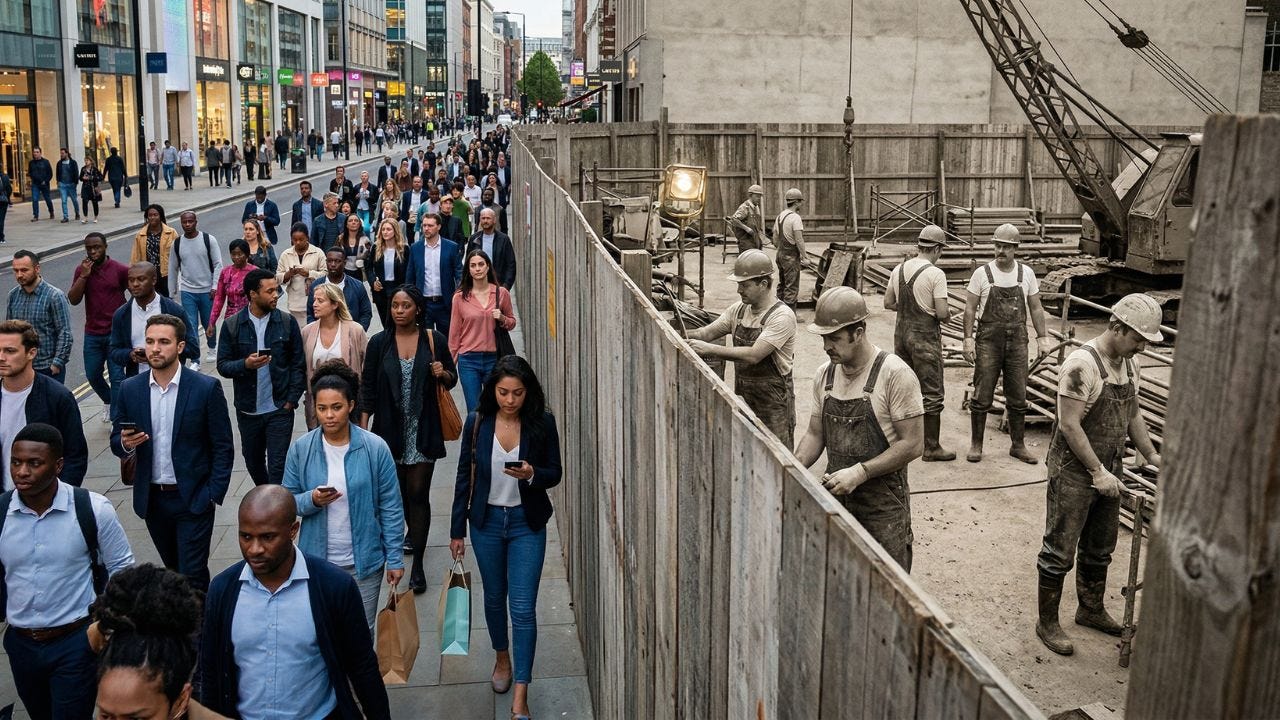
My local high street comprises about 30 shops, including both a Co-op and a Sainsbury’s Local. It also includes two Chinese takeaways, an Indian restaurant, and a Bangladeshi restaurant; a woman’s boutique run by a lady from Poland; a traditional English butcher; two Turkish barbers; and a tobacconist run by a nice guy who hails from Iran.
Britain, as they say, is a melting pot - a heady mix of nationalities, races, creeds, colours, and beliefs. I’ve never known any different. I grew up in London and went to a primary school that was roughly half Black and half White. When I moved out to leafy Surrey, one of my closest friends through school, college, and beyond was Indian. In fact, when I occasionally find myself at an “all-White” event, I notice it. It feels odd to me.
I’d like you to think about the site you’re on or the office you’re working in right now. How many people are you working with? A dozen? 20? More? Well, for the sake of this exercise, let’s imagine that you work alongside precisely 100 people.
According to the Office for National Statistics (ONS), approximately 7% of people voted for the Green Party at the last General Election. 12% voted Liberal Democrat, 14% voted Reform, almost 24% voted Conservative, and more than 33% voted Labour (although I wonder how many of those plan to do so again). On that basis, seven of your 100 fictitious colleagues voted Green.
The ONS also suggests that people with ginger hair make up roughly 8.4% of the population, although there is a big Scottish/English divide. In England, only 4% are ginger, while they are about 13% of the Scottish population. So, look around. Are eight of your imaginary colleagues ginger?
If you haven’t figured it out already, I can tell you that this article is about representation. It’s about representation in the UK demolition and construction industry. To be more precise, it’s about the lack of representation and diversity in an industry that is one of the nation’s biggest employers.
Sticking with those ONS figures, of your 100 entirely made-up colleagues, it is likely that two of them are lesbian or gay, and that at least one of them is bisexual. In truth, those figures might be entirely accurate, but we’ll never know: partly because of our British reserve, but mostly because any sensible gay person working in this sector would be wise to keep their sexual orientation on the down-low.
But there’s no keeping the greatest disparity on the down-low: that of gender. Women make up 50.7% of the UK population. If you’re on a fictitious site of 100 people, half of them would be women. In reality, just 14% of the construction workforce are female, and even that figure is skewed by women in “non-front line” roles. At site level, females account for only about 4% of the workforce.
In the outside world, beyond the hoarding, it is 2026. On site, the glass-ceiling age of Benny Hill persists.
Think about that imaginary 100-person workforce again. If it were truly representative of the UK population, around 74 of the 100 would be White British, while 9% would be of Asian origin and 4% would be Black. I remember meeting a Jamaican demolition manager and a Sikh supervisor in recent years. But I remember them because they were anomalies. Even on sites where there are migrant workers, they tend to be White and of Eastern European extraction.
I know what you’re thinking and, in truth, I agree: jobs should be awarded on merit, not to tick a box on an inclusivity checklist. But in these supposedly enlightened times, are we really suggesting that straight, White men are blessed with some God-given talent for demolition and construction that no other people possess? Or is it an affinity bias, in which we subconsciously tend to hire and employ people who look like ourselves?
Before we get too bogged down in all that, I’d like you to think of your 100 imaginary colleagues one last time. How do they look? Do they look well? Healthy? It would be surprising if they do, because national stats suggest that half of them are suffering with high cholesterol which - if left undiagnosed - could result in cardiac arrest. Probably 10 of your imaginary colleagues have undiagnosed heart disease, and a third of them have undiagnosed liver disease. But there’s no point in trying to tell them about it, because more than a quarter are likely to be suffering with hearing loss.
As much as we like to claim otherwise, the UK demolition and construction industry is not representative. Not even close. If it were, we wouldn’t need “women in construction” initiatives. It’s 33 years since the launch of the “Kick Racism Out of Football” initiative. In light of the overwhelming whiteness of our sector, perhaps we’re due a “Kick Racism Out of Construction” campaign.
We pride ourselves on building the future, yet we’re doing it with a workforce that is seemingly stuck in the past. If our industry truly wants to survive the next decade, we need to stop hiring in our own image and start looking like the country we’re building for. Because right now, the only thing more shallow than our diversity stats is the pool from which we’re drawing our workforce.
If you enjoy the insights here at Demolition Insider, do not let the conversation end with today’s post. There is a wealth of industry analysis waiting for you in our archives; have a look at our three most recent deep dives below to see what you might have missed.
If you find our work valuable, please consider sharing this article with a colleague or friend who would appreciate a sharper perspective on the trade. Better yet, ensure you never miss a daily update by taking out a full subscription today using the button below. Your support is what keeps our reporting independent.