Ready Player One
In a world where machines watch, measure and judge, a young operator learns that competence cards mean nothing; because the real test begins when the system starts scoring you.
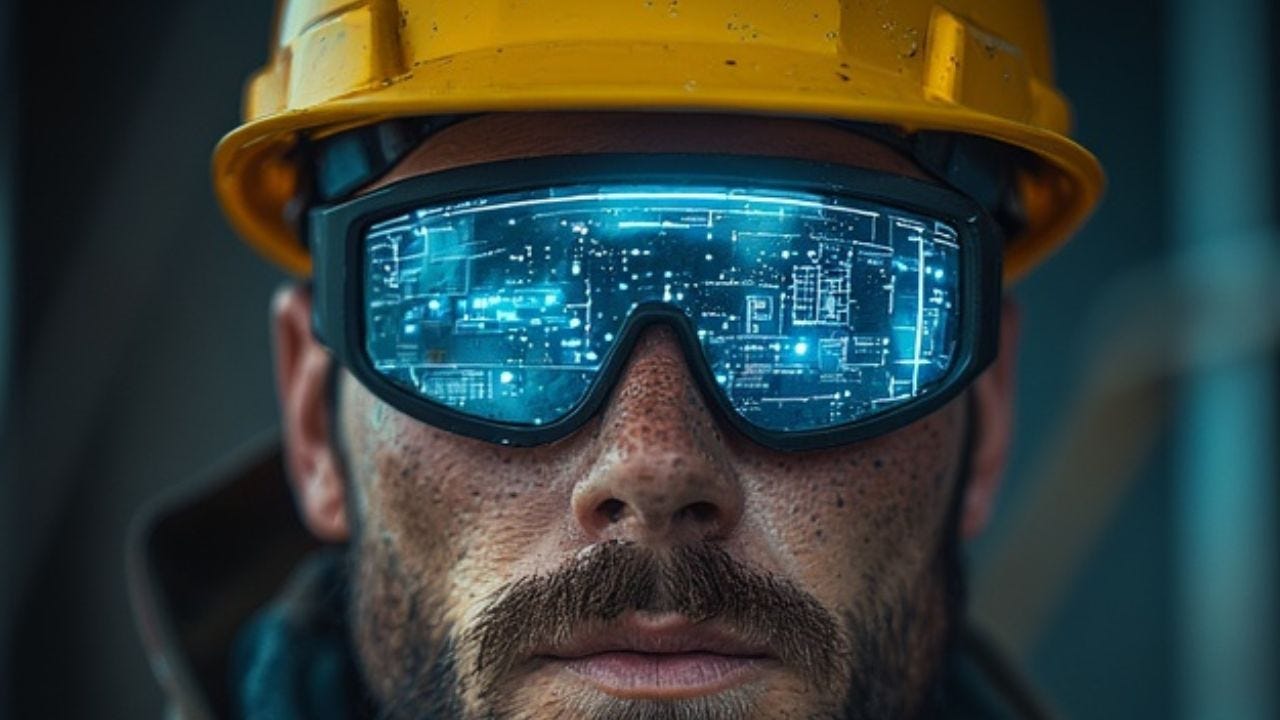
The heads-up display in his machine flashes electric blue. “Welcome trainee Riley - session one.”
Riley is 19 years old. He holds an old-school competence card that proves he passed the test at college. But here on site, he is a newbie. A rookie. Unqualified.
He slides into the seat, adjusting it along with position of his joysticks. Everything about the machine’s interior feels at once familiar and welcoming, yet alien and even menacing.
As he puts on his headset, the heads-up display changes. Instead of his name, the display scrolls through machine functions, analysing every component, every action. The display settles on a display that is alive with data streams: power consumption; wear index boom; wear index undercarriage; wear index attachment. These readings rise and fall like sound waves before setting to their current state. A red LED flashes, showing that the in-cab camera is working and that he is being watched. Unbeknown to Riley, the in-cab air filtration system has already analysed his breath for the presence of alcohol.
A voice crackles in the headset, crisp but impersonal: “Trainee Riley, your telemetry is online. Let us begin.”
His first few cycles are careful, slightly tentative. The machine logs his electricity consumption at three percent above optimal. The attachment wear-index creeps up by 2.3%. The cab-camera scans his eyelids, his head position. It flags a “micro-blink count high” alert that makes Riley’s palms sweat. He had passed the competence card test with flying colours. Top of his class. He has the certificate under his belt. But here, live on site, everything is under the microscope.
Behind the scenes, in a global network deep within the system’s tech infrastructure, data is streaming in from hundreds of thousands of machines, across thousands of sites, across countries and across continents. Telemetry, grade control, alertness monitoring, cycle times, idle times: all feed into an AI engine called Aurora. Among its tasks: benchmarking operator performance, identifying patterns, flagging weaknesses, issuing training prompts and yes, ranking.
Riley was told he was competing against other operators on this site. He liked the friendly angle: “best-operator of the week”. But the truth, he sensed, was darker. He is competing globally. A digital leaderboard sitting in the global headquarters of DEMOCO, the creator of the Aurora system, glows with names, countries, scores, badges. Operators from Tokyo, Houston, Dubai. At the top, elite operators compete for the top jobs around the world. At the bottom, operators fight to retain their jobs; to retain their right to work.
By week two Riley is improving. The electricity consumption display now glows in a reassuring blue. The wear-index hovers between green (which is good) and yellow (which is a sign that something might be awry).
The machine chirps: New badge: “Efficiency +” unlocked. He feels a surge of pride even though he is not surprised. He has begun to anticipate cycles, boom positions, attachment changes. He’s heard the quiet whispers of his crew: “He’s one of us now.”
Yet inside his head the voice of the AI also haunts him: Fatigue alert: probability 0.68. Confirm readiness.
One afternoon, after lunch, his eyelids feel heavy. The in-cab camera spots it immediately. The seat vibrates; an alert flashes: Take 10-minute break or enter training module now. He knows he hesitated, chasing production numbers, desperate to climb the leaderboard. But the machine locks the shear for a two-minute mandatory pause. In those two minutes he stands, stretches, and realises that he is a long way from his college classroom.
Halfway through the month, there is an incident. A section of concrete collapses more quickly than the plan predicted. An unexpected shockwave rattles the machine’s sensors, the boom jolts. The system logs a “transient over-angle event”. In milliseconds, the AI logs Riley’s reaction time, his adjustment of stick and boom, his joystick response. The cab-camera registers one tiny lapse. He’d looked away just as the concrete gave way.
The machine voice comes: Alert: operator performance below threshold. Reviewing session. Training module triggered. Riley’s heart sinks. The global network won’t forget. The leaderboard flickers, and his name drops from rank 4 to rank 12 on the site leaderboard.
Globally, his position plummets.
The site manager isn’t angry. He is mechanical: “Riley, take the simulator this afternoon. Run 10 cycles, then we’ll re-assign you until you clear.” Riley nods. He knows the rules. He has to earn his seat all over again.
Six months in, Riley has a rhythm. He’s no longer operating the machine, he’s managing it. He monitors the screen himself, anticipating when system temperatures climb. He treats the cab-camera as a mirror, keeping his posture, and his focus. At shift-change he clicks “Session complete – ready for benchmarking” and watches the global board refresh: his name climbs. He’s unlocked another badge: “Global Tier-1 Operator”.
He should feel proud; and, in a way, he is. But he’s also painfully aware that the game isn’t over. It is just beginning. And while he is driving the machine, the machine and the system is driving him.