

Water, water, everywhere
Hotter summers, PPE, sprawling sites, demanding deadlines, and a caffeine-fuelled culture combine to make demolition and construction the most hydration-challenged sector in Britain.
There is a thing that people like me do when we are about to talk about a cause, particularly when we are trying to raise money for it. We say: “This is a cause that is very close to my heart.” Well, in this case, I mean it.
Many years ago, I got a call from my best friend to say that his youngest daughter had been rushed to hospital. They had been out all day when his three-year-old daughter basically just collapsed. She was taken by ambulance to a hospital in London. I left work and drove into town, stopping only to buy a little teddy bear on my way. When I arrived, I found my best friend pacing the corridor. He said that she had basically just passed out and that they could not revive her.
I went in to see her. This tiny little girl with wires and tubes coming out of her. I gave her the teddy bear and I spoke to her for a while. The doctors confirmed that she had suffered a brain bleed and that her little life was literally hanging in the balance. I stayed for a while, trying to comfort my mate who was—as you would expect—inconsolable. On the drive home, I called my wife to give her an update. As I was telling her what I had seen and what the doctors had said, I broke down. I had to pull over. I just sat there and sobbed.
Thankfully, that little girl is now in her 20s. That brain bleed has left her prone to seizures. In all likelihood, she will never be allowed to drive. And all of that was caused by a seemingly innocuous thing: severe dehydration.
With all that in mind, we have to talk about something that usually gets brushed off as a bit of a “soft” topic. We need to talk about heat health and the reality of staying hydrated.
The official Heat-Health Alert season in the UK kicks off on the first of June and runs right through to the end of September. Now, for many of us, that just sounds like the time of year when the work gets sweatier and the PPE gets itchier. But the reality is that the construction sector is probably the most hydration-challenged workforce in Britain. It isn’t because anyone is thick or does not realise that water is important. It is because the way a site actually functions is almost perfectly designed to make you fail at staying hydrated.
Think about the last time you were on a major demolition job or a massive new build. If you are three storeys up or right at the back of a sprawling site, that water refill point might as well be in the next county. When you are in the middle of a task, or you are trying to hit a specific milestone before the end of the shift, the last thing you want to do is down tools, climb down, trek across the site, and wait to top up a bottle. You tell yourself you will grab a drink when the job is done, or at the next scheduled break. But while you are pushing through, your body is paying a price you might not even notice until the headache kicks in or your focus starts to slip.
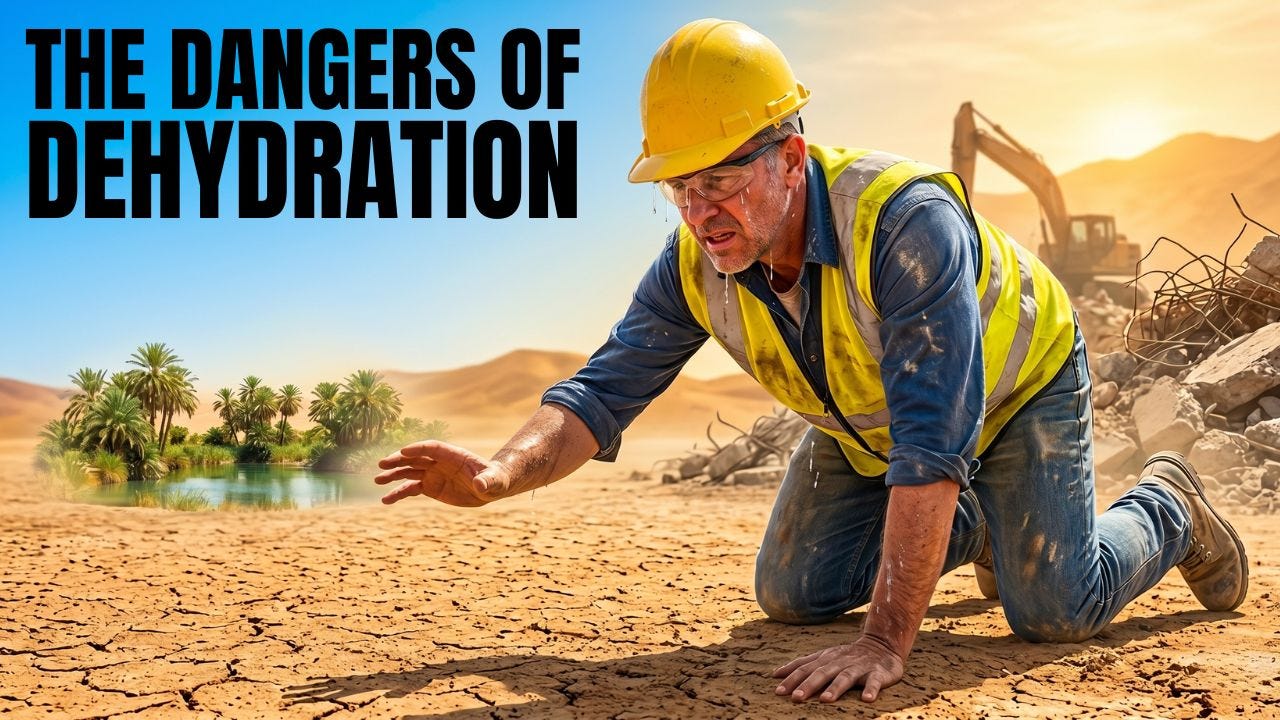
Then you have got the PPE. We wear it because we have to, and we wear it because we are professionals. But let’s be honest: in twenty-five-degree heat, a hard hat, gloves, and heavy-duty high-vis gear turn into a personal sauna. Your core temperature climbs, and the more you sweat, the more your blood thickens, making your heart work twice as hard just to keep you upright. Taking that gear off to have a drink feels like an interruption, a break in the momentum. So, we delay. We keep going. And that is where the danger starts to creep in.
You want to get the job done, and hydration feels like an inconvenience. Water becomes the thing you will sort out later, but by the time later arrives, fatigue has already taken hold.
There is also a bit of a “silent trade-off” that we do not talk about enough on site, and that is the issue of toilet access. It sounds basic, but we have all been there. If the site toilets are a nightmare, or if they are situated miles away from where the actual work is happening, some people will consciously drink less water just to avoid the hassle of having to go. It is a survival tactic, but it is a dangerous one. If you are rationing your water intake because you do not want to walk to the portable loo, you are essentially sabotaging your own ability to think and move safely.
Let’s look at the culture for a minute. In this country, sites are fuelled by tea, coffee and—increasingly—energy drinks. It is part of who we are. A brew is more than just a drink; it is a moment of headspace, a bit of a social reset. Research tells us that about twenty-eight per cent of Brits say they rely on caffeine just to stay productive, and nearly half of people think that tea, coffee, or energy drinks actually count as hydration. But here is the cold, hard truth: when the heat is on and you are grafting, those drinks are not your friends.
Caffeine is a diuretic. It basically sends a signal to your kidneys to get rid of water. So, if you are already losing fluid through sweat and then you top it up with three or four strong coffees, you are actually making the dehydration worse. You are flushing out the very stuff your body needs to keep your brain sharp and your muscles moving. Energy drinks are even worse because of the sugar spikes and the inevitable crashes. They might give you a ten-minute buzz, but they leave you more vulnerable to heat exhaustion in the long run. The HSE does not put out guidance just for the sake of it; they specifically advise frequent sips of cool water precisely because caffeine does not afford the hydration levels required for the physical load we carry.
We have to stop thinking about hydration as a “wellness” thing and start seeing it as a performance and safety thing. If your body loses just two per cent of its water, your concentration starts to tank. In an industry where a second of distraction can lead to a serious or possibly fatal accident, being dehydrated makes you a liability to yourself and the rest of the crew.
The side effects are not just a bit of a dry mouth. It starts with a headache that you try to ignore. Then comes the light-headedness. You might find yourself getting unusually irritable with your mates or struggling to focus. From there, it moves to muscle cramps, which are your body’s way of screaming that its electrolytes are gone. If you keep pushing, you hit nausea and dizziness. That is the point where heat exhaustion is knocking on the door. And if you cross that line into heatstroke, you are looking at a genuine medical emergency that can do permanent damage to your internal organs. It is not about being tough enough to handle the sun; it is about biology. You cannot out-tough a lack of water any more than you can out-tough a lack of oxygen.
A professional athlete would not dream of starting a game dehydrated, and what we do is just as physical. You should be drinking a good amount of water before you even step foot on site. If you start your shift in a deficit, you will be chasing your tail all day and you will never truly catch up.
On site, we need to move away from the idea of “the big drink.” Gulping down a litre of water at lunch does not do much because your body can only process so much at once; most of it just goes straight through you. The trick is the “little and often” approach. Small, frequent sips every fifteen or twenty minutes keep your hydration levels steady and keep your brain switched on.
And for the managers and the ones running the sites, the responsibility is just as big. Do not make the lads trek across a building site for water. Get it to the work zone. If it is easy to reach, people will drink it. In the peak of the summer heat, we should be looking at shorter, more frequent breaks in the shade. It is better for the job to take ten minutes longer than to have someone collapse or make a catastrophic mistake because their brain is foggy from the heat.
We also need to keep an eye on each other. If you see a mate who is usually sharp starting to fumble, or if they are looking a bit flushed and not making much sense, do not just tell them to get on with it. Get them some water and get them into the shade for five minutes. It is about site culture. We look out for each other when it comes to harnesses and hard hats; we need to start doing the same when it comes to the heat.
As the summers continue to get more intense, staying hydrated has to become a core part of the trade. It is about ensuring that at the end of a long, hot shift, everyone walks off that site in the same condition they walked on. So, keep the brews for the start and the end of the day if you must, but when the sun is out and the work is hard, make sure the water is the first thing you reach for. It is the only way to stay cool under the kind of pressure we deal with every single day.