

What Keeps Us Here?
Highly valued abroad, yet expendable at home, the UK’s skilled demolition and construction workforce is standing at the exit. So, what keeps us here?
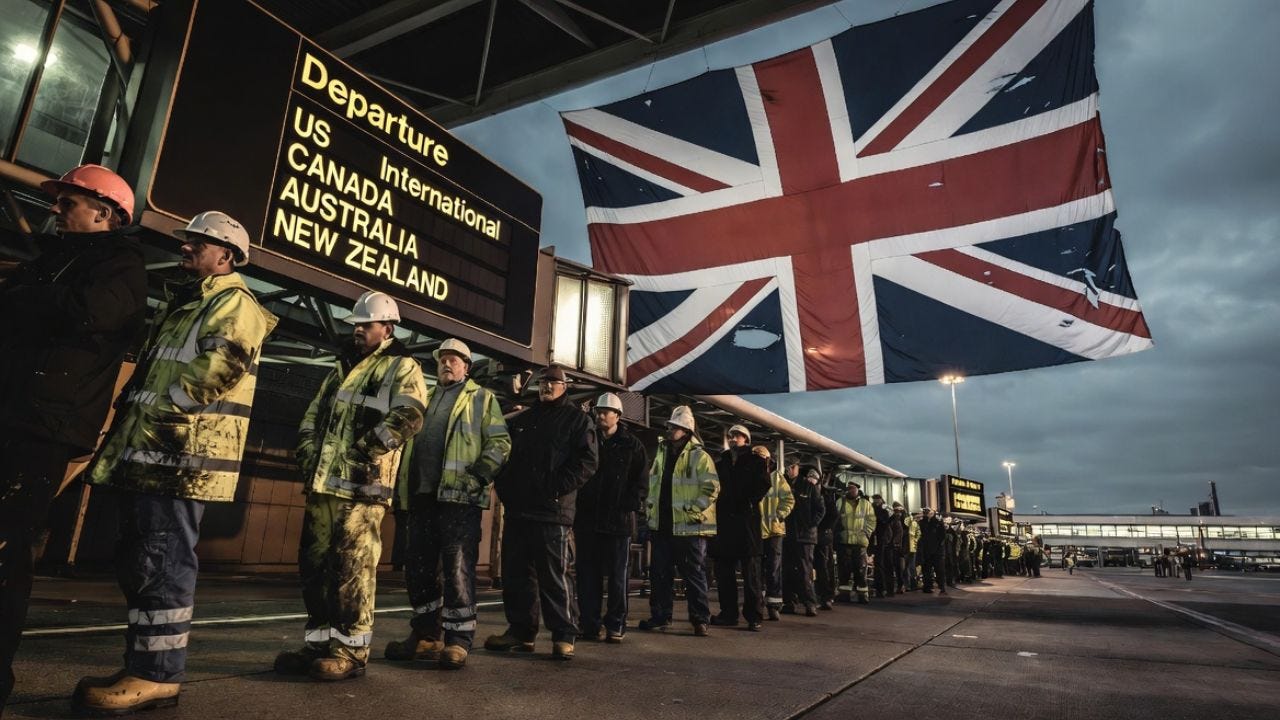
The sky is the colour of a bruise, and the air on-site is thick with a heady cocktail of pulverised concrete, diesel fumes, and the kind of damp cold that settles in your marrow and stays there until July. You stand there, high-vis faded to a dull mustard, site boots heavy. And that familiar question begins to circulate through your mind.
What keeps us here?
It isn’t the prestige. Let’s be honest: to the man in the suit hurrying past the hoarding, or the client signing off on the next urban regeneration project, you’re invisible. You are not seen as the skilled operator of machinery. You are seen as an expendable resource. You’re a line item on a spreadsheet, a flickering light that can be switched off the moment workloads dip or the weather turns.
The industry is a meat grinder. It is willing to sacrifice your knees, your back, and the very air in your lungs. In return, it offers the precarious security of a zero-hours culture. We operate in a landscape where the word asset is reserved for the plant and equipment, but never for the people that operate them.
Your opinion? Don’t make me laugh. In an industry beset with genuine, life-altering hazards, those at the coalface are the last to be consulted. Decisions are made in air-conditioned offices by people who haven’t set foot on site in a decade, if ever.
We are constantly told we are unskilled or semi-skilled, a convenient lie used to keep wages suppressed and representation thin. We work in the rain, the sleet, and the blinding dust, underpaid for the risk we take and undervalued for the expertise we bring. There is no work-life balance here. There is only the work, the commute, and the exhausted collapse into sleep before the alarm screams again at 5:00 am.
We are treated as pick-up, put-down commodities. If the workload dictates, you’re the hero of the hour; if the funding stalls, you’re out the gate. Your proven skills are questioned at every turn by a box-ticking bureaucracy that cares more about the colour of your card than the quality of your work.
So, as the rain drips off the brim of your hard hat, you have to ask yourself, What keeps us here?
What keeps us here?
This time, the question isn’t just about the site. It isn’t about the foreman’s attitude or the lack of a decent pension. It’s about the very ground we stand on. We are told that the UK is a global leader, a titan of industry and culture. But look around. Look at the reality of life in Britain in 2026.
If you have a UK demolition or construction qualification, you are holding a golden ticket. You are a person of value in the global market. In Western Australia, they’d bite your hand off for your experience. In Canada or the US, your “unskilled” hands would be rewarded with a standard of living that feels like a fever dream compared to this. There, you are a specialist. There, the pay reflects the skills you bring.
Yet, we stay. We stay in a country where the standard of living is falling through the floor while the cost of living screams toward the ceiling. We live in a nation that has forgotten how to look after its own. It is a staggering, shameful indictment of our society that we have old people forced to sit in the dark because they can’t afford both a hot meal and a warm radiator.
Our infrastructure is a joke told in slow motion. Our roads are a lunar landscape of potholes, and our rail network is a vanity project for the wealthy. It is a literal, mathematical absurdity that it can cost more to take a train from London to Glasgow than it does to board a plane and fly across the Atlantic to Los Angeles. We are a captive audience in a crumbling theatre, paying premium prices for a seat that is falling apart.
The social contract hasn’t just been torn up; it’s been put through the industrial shredder. We work ourselves to the bone to pay for rents we can’t afford and mortgages that feel like nooses. We contribute to a system that views the working class as a demographic to be managed rather than a community to be served.
Why do we remain? Is it a misplaced sense of loyalty to a flag that doesn’t fly for us? Is it the fear of the unknown, or the exhaustion that prevents us from even looking at a map?
We have the skills to build a life anywhere in the world. We have the toughness to survive in the harshest environments on the planet. We are highly valued everywhere else, yet we remain in a place that treats us as an inconvenience.
So, I ask you one last time, as you look at your payslip, as you look at your heating bill, and as you look at the decaying streets of the town you call home:
What keeps us here?