

When the humans have gone
The march toward autonomous equipment promises safety and efficiency gains. But it’s also dismantling the supply chain, as human-focused components lose relevance in tomorrow's machines.
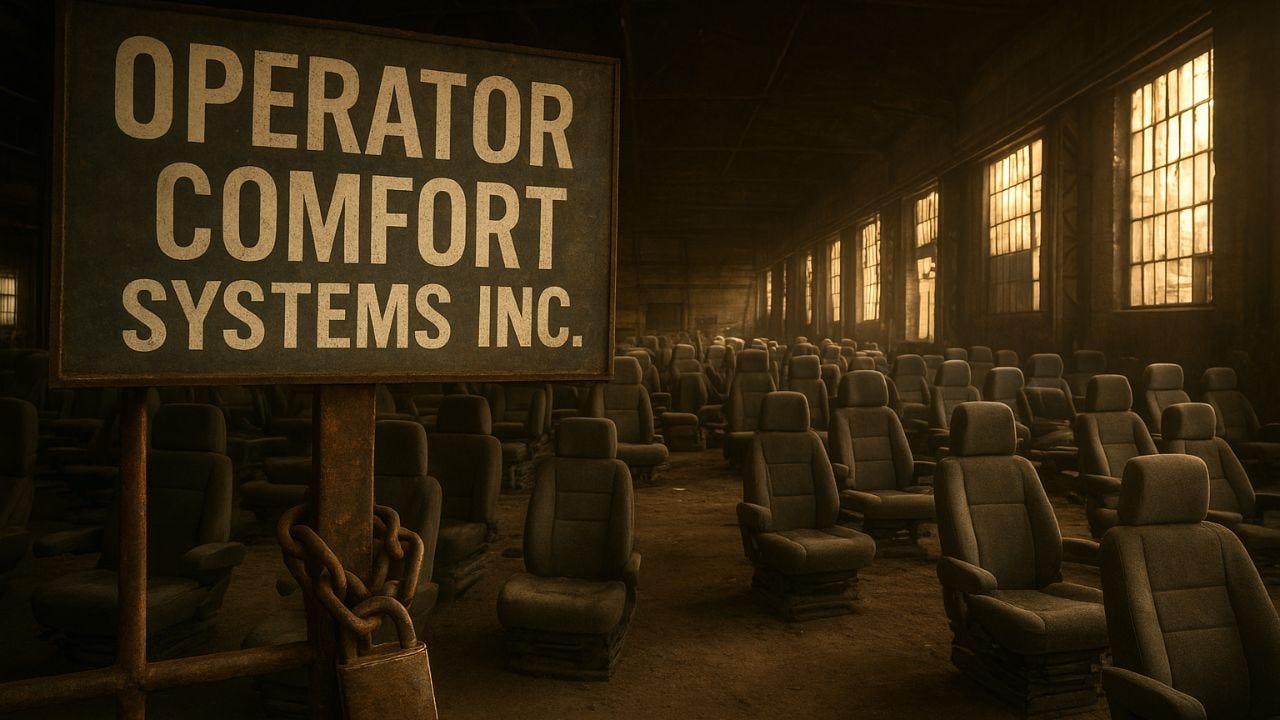
In the heavy equipment sector, the shift toward autonomy is usually discussed in big, headline terms: fewer operators in the cab, higher productivity, improved safety, lower labour costs. These are unquestionably real and important.
But beneath those transformative themes lies a quieter story — one of how the ecosystem inside every machine is being quietly redesigned, re-valued, and, in some cases, sidelined entirely. For suppliers of seats, joysticks, heating and air conditioning systems, handrails, steps, and even cup-holders, the march of machine autonomy signals profound disruption.
Imagine the traditional excavator, loader, or dozer. It is built around a human being in the cab: seats designed for comfort; access ladders and handrails to reach the cab; pedals, joysticks, and instrument panels to control the machine; air-conditioning and noise insulation to ease the operator through a long day; storage pockets and even a cup-holder for convenience. It’s an ecosystem of parts designed around human presence.
Now imagine that human is no longer in the machine. What happens to the seat, the pedals, the handrail, the climate control, the cup-holder?
The global market for autonomous construction equipment continues to grow strongly. Estimates place its value in the tens of billions of dollars today, with projections climbing sharply into the next decade as semi-autonomous and fully autonomous machinery become more practical.
The key drivers include major forces: labour shortages, rising safety demands, pressure for higher productivity, and advances in sensors, AI, and connectivity. As machines become smarter and more self-reliant, the implications ripple far beyond “just software” and “just operators.” They reach into the physical architecture of the machine and the parts-supply chain that supports it.
Take, for example, a machine concept that eliminates the traditional cab entirely and places the operator elsewhere — or removes them altogether. If a machine requires no human in the field cab, many of the parts once considered essential become redundant or radically redesigned. The operator’s seat disappears. The entry ladder and handrails are removed or simplified. Pedals and joysticks vanish or migrate to a remote-control station. Even the cup-holder — once a symbol of human convenience — no longer makes sense. What seemed a minor component suddenly becomes emblematic of a far more fundamental shift.
For parts suppliers that historically built around human-in-cab systems, these changes bring both risk and opportunity. Suppliers of handrails, steps, and seats may see volumes drop.
On the flip side, there are openings to pivot — toward remote-operator stations, ergonomic console chairs, display modules, sensors, and remote-control hardware for operators supervising multiple machines.
And those multiple machines are the kicker. In today’s human-led industry, one person operates one machine. In a future of autonomy and remote operation, one person might manage two, three, or even more machines from a single station. In that scenario, demand for traditional seats could plummet.
The business-model implications are broad. OEMs may consolidate or internalise more of the cabin or remote-control architecture now that fewer human-occupied cabs exist, reducing the number of specialist suppliers. The cost profile of machines shifts — away from comfort-oriented hardware and toward autonomy-enabling hardware.
Suppliers whose value lies in comfort may need to adapt or face obsolescence. When a site transitions to remote-controlled equipment, all of the steps, handrails, and operator seats on that machine become redundant.
Of course, this transition will not happen overnight. The vast majority of machines in the field today remain operator-occupied. Many job sites — especially demolition, tight urban spaces, and complex terrain — still require human presence due to regulatory, safety, or complexity reasons. Autonomous systems still struggle in unstructured and dynamically changing environments. Regulations and safety standards around operator-less machines are still evolving, and many machines may still require a minimal cabin for maintenance or manual override. Some OEMs will retrofit existing fleets rather than replace them outright, giving component suppliers a window of transition. But if they’re not scanning the future horizon nervously now, they probably should be.
Step back, and it’s tempting to view autonomy in construction equipment purely through the lens of safety, labour, and productivity gains. But the shift runs much deeper. It redesigns the machine’s human-interface architecture — and with it, the entire downstream parts ecosystem.
For suppliers of seats, joysticks, HVAC, steps, handrails — and yes, cup-holders — this is a strategic inflection point. The machines will still move. But how they accommodate (or don’t accommodate) a human operator is changing.
The big story may be the operator-less machine and what that means for those who run them. But the quiet story is about those who supply the machine’s human interface — and whether we’ll still need them in the future.
It's interesting how you spotlight the profound shift in machine ecosistems. Thanks, very insightful!