

Looking but not seeing
Is high vis' clothing actually making demolition workers invisible?
If you live in the UK and have a TV, the chances are you have seen the commercial for Febreze in which they talk about becoming so accustomed to foul odours in our homes that we have, in effect, become “nose-blind.”
I have to be honest: I initially assumed that the term “nose-blind” was created by an advertising agency to help sell more cans of spray. But it turns out it’s a real phenomenon. “Nose-blindness,” or olfactory fatigue, is when your nose stops detecting a familiar smell after prolonged exposure. Perhaps that’s the reason those working at waste transfer stations and landfill sites can tolerate what - to the rest of us - is a pretty unpleasant whiff.
Although totally unconnected, my thoughts about nose-blindness were triggered by two things this past week. The first was a discussion about site fatalities in the UK demolition and construction industry in 2024/25. The second was an article about the true purpose of personal protective equipment (PPE) and high-visibility clothing.
During the discussion about fatal demolition and construction incidents, one of the participants pointed out that all 35 people killed during the 2024/25 period died as a result of falls from height. To put that another way, none of the fatal accidents during the last recorded period could have been prevented by PPE. You can wear all the high-vis clothing, hard hats, site boots, safety gloves, and glasses you wish, but none of it will protect you if you fall from height.
It’s also worth noting that there are two other “unofficial” causes of death in the industry that are likewise not prevented by PPE. Deaths from asbestos-related diseases will have topped the 2,000 mark during the same period. In all likelihood, there will have been around 500 deaths by suicide in that time as well.
Now, don’t get me wrong. I am all for health and safety measures. I have no problem with working men and women wearing PPE. I own several sets myself, and I wouldn’t even think of walking onto a site without it. But it is noteworthy that the most visible form of health and safety in the demolition and construction industry actually had no bearing on this 2,500+ annual death toll.
Within a few days of that discussion, I came across an article by Andrew Groves, Professor of Fashion Design at the University of Westminster, in which he discussed the true function of high-vis clothing. There were a couple of sentences in his article that really resonated:
“High-vis is the most conspicuous part of our visual environment, yet also the easiest to ignore. You see it without really registering it. It sits in the background, doing its job.”
He continued:
“Fluorescence was never about the person; only the task... The worker vanishes behind the logic of safety. And when something is everywhere, it becomes invisible by design.”
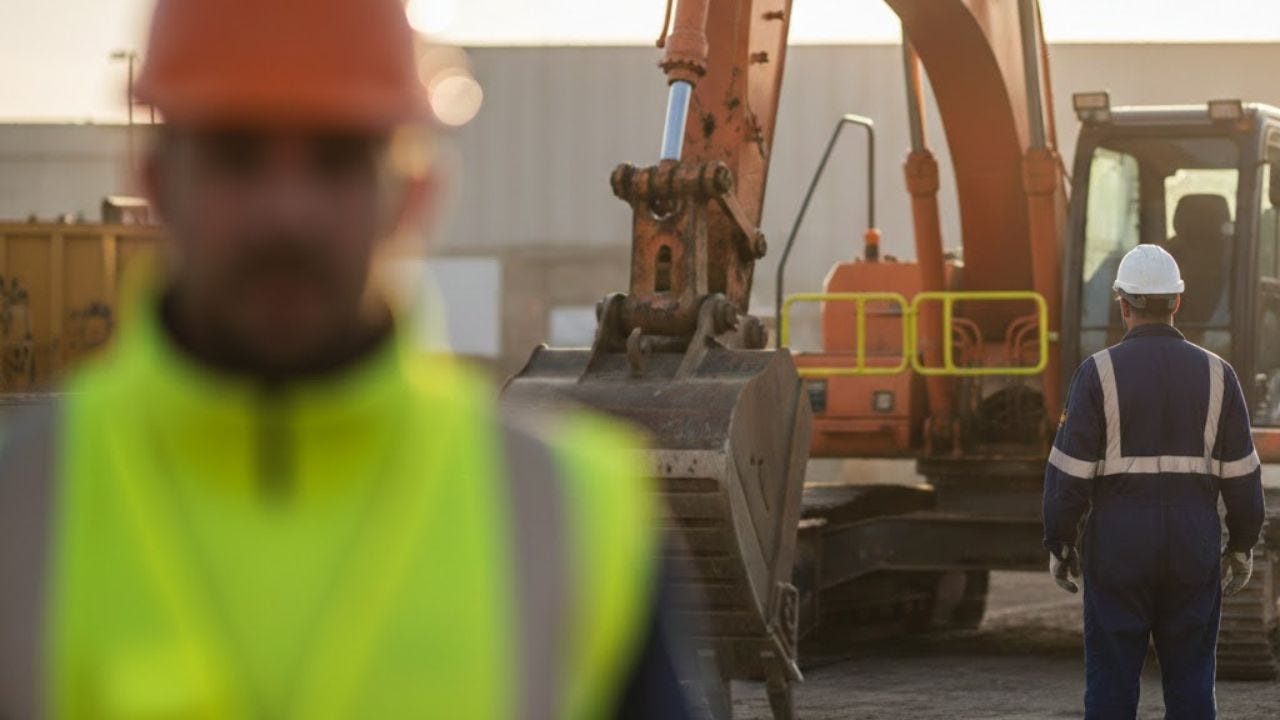
And here’s the thing: on demolition and construction sites across the world, those fluorescent vests, jackets, and trousers are everywhere. Have we tuned them out? Have they become so familiar that we barely even register them anymore? Have we become “high-vis blind”?
Before we get into all that, I have a couple of quick points. Firstly, if high visibility and fluorescent colours truly worked, why have we not insisted that all site equipment be painted bright yellow or neon orange? There is a trend at the moment to paint handrails and excavator “boxing rings” in fluorescent yellow, presumably so we can see them more clearly. That’s fine for operators that are up close with those grab handles; we wouldn’t want them to miss those. But what about colleagues working close by? If high-vis really worked, would it not be a good idea to ensure the whole machine was fluorescent?
Furthermore, has anyone given any real thought to the nature of seasonal lighting conditions? Let me tell you a quick story.
My dad was a very good fisherman; a match angler. In his tackle box were all the things you might expect: hooks, fishing line, lead weights, and floats. He had lots of floats, each painted black with a fluorescent orange or yellow tip. When that tip sank below the surface of the water, it was an indication that a fish was (hopefully) on the hook.
But alongside all those floats, my father always had a black marker pen. Because sometimes, at the height of summer when the sun was shining, he would use that marker pen to colour that fluorescent tip black to make it stand out against the brightness of the water.
So, would black PPE work better during certain parts of the year? Before you dismiss this as the ramblings of a madman, consider this: In 2019, I visited Japan as part of a European Demolition Association study tour. When we visited a demolition site, we were all given the usual yellow and orange high-vis vests. But the workers on the site were wearing pristine navy blue overalls emblazoned with fluorescent white stripes. To my Western eyes, those Japanese demolition workers not only looked smarter than their European counterparts, they also stood out superbly against the Japanese sunshine.
Having thought about this subject for longer than is likely healthy, I am left with several questions. If high-vis works for people, why isn’t it being applied to equipment? If it’s really about standing out, is there not a time and a place for navy blue or even black high-vis clothing?
And perhaps the biggest question of all: Is high-vis clothing really about safety? Or is it, as Professor Andrew Groves suggests, about conformity, compliance, adherence to rules, and the suppression of expression?
Great to read you thoughts on this as a specialist, Mark. It's also resonated with people that design PPE as well.
I often use the comment to push home the point that PPE is the lowest form of control by asking what is the point of hi viz. Does it really make you more visable or does it just make you look like a construction worker.